Sitting meditation is typically a second step in Qigong systems aimed at health and healing. The standing forms help sitting practices go easier and deeper. Modern people have a lot of stress and repetitive motion issues that ancients did not have: Standing practices seem to unwind those layers. Depth is the goal with sitting meditation. Anyone with physical limitations can start with sitting: I have taught patients in wheelchairs. While they do incredibly well with participating in standing sessions as they are able, they may feel more empowered with this.
Wang’s teaching of Turtle Qigong began with the simple Standing form (Part 1), but he was quick to introduce the first part of the sitting form. This is a guided meditation through the organs. It follows the nourishing cycles found through the practice of acupuncture. I found it to be very balancing for the emotions.
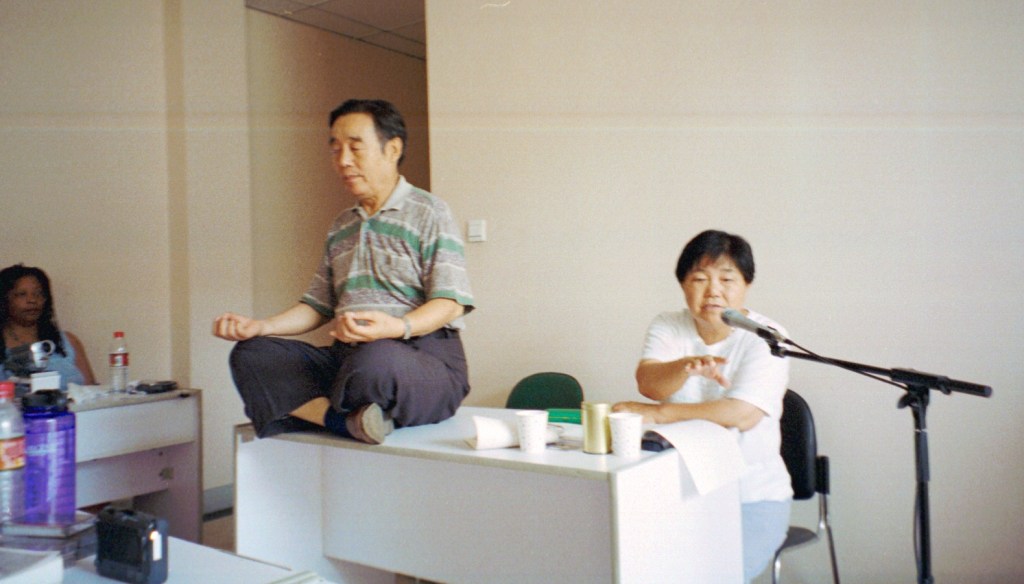
Click here for an audio file of a half-hour sitting meditation of Turtle Qigong (Part 3) ‘Being the Turtle.’ It has 5 parts plus a finishing form.
This is free for students in my classes. All others are encouraged to make an adjustable donation that supports sharing Qigong by clicking here.
Notes from teaching this form-
I taught this sitting form to over 100 students and patients a week for over 9 years. Each week, I would add 1 or 2 of the sections of this sitting form. As with the others, it was amazing to watch the energy build and go deeper over the course of a term.
Many students already had a very developed standing practice of some kind, whether yoga or a martial art. They could learn something from new standing forms, but especially enjoyed the different experience of a sitting meditation like this one. The reverse was true for experienced meditators, whether Tibetan or Insight: they could learn a few things from this sitting form to support their existing practice, but were thrilled with the standing forms as a fine complement to their meditations.
Sitting position– Either the floor or a chair works equally well. Have the spine free so that it can have its natural curves.
All Qigong forms play with the left-right polarity of the body. The thinking in this form is for the Yin to embrace and calm the Yang, and for energy to naturally go deeper into the body. This form (along with Soaring Crane) posits that the left is Yang for male-identified bodies, and the reverse for female-identified. For students curious about this, we had little experiments where they would cross their legs or hands both ways to explore the different feeling. Most didn’t need to think about it. Qigong is like playing music: you play the notes on the page, the sound fills your instrument, and then you get swept up in the feeling–not the details.
Hand position– The hands, like everything else we usually take for granted, can have a noticeable impact during a meditation. In this form, the palms are up for the first 3 sections and then down for the last two. The palms in acupuncture are an extension of the Heart. When the palms are up, we are connecting more with the Yang of the sky, its clarity and energization. Turning the palms down guides the Qi down and Yin, which is more internal and deeper. There are so many ways to take in Qi. This form also starts with the thumb touching the middle finger (a mudra position in Yogic practices). Working with fingers can also set the stage for an energetic experience. Wang said this was designed to bring more Qi to the Heart.
The feet– The legs are crossed in this form. Some Qigong meditations have feet on the floor. In acupuncture, we spend a lot of time feeling qualities in the radial pulse on the wrist (going to the thumb). It was instructive to feel the pulse while comparing feet on the floor and ankles crossed: Students could feel the pulses weaken with legs crossed. This is one way to calm the mind and breath. Having feet on the ground is what happens with standing forms, where the Qi is opening, clearing and moving powerfully. This sitting form is inducing the calm of the turtle in many ways.
Section 1, an Organ Cruise– Chen encouraged us not to practice Qigong when upset. However I found this part of the sitting form could induce a state of peace in about 5 minutes. Chinese medicine posits the emotional and spiritual life to be a factor of the organs, more so than the brain. Students began relating to this practice in 3 ways:
- Physical– A knowledge of anatomy helps bring the Qi to the zone of the organ. It does not need to be exact, but a rough idea helps to get the Qi into various parts of the organs. Have a look at Google Images if needed. However a purely physical viewpoint here can be limiting. Some students who were doctors and nurses reported having to overcome their conditioning of seeing organs in emergency settings and cadaver labs. They were able to do this in a few weeks.
- Energetic– This is the main aspect of the experience. It helps to feel into the space to connect with Qi. Colors are sometimes suggested or–better yet–spontaneously appearing as part of the meditation.
- Symbolic– At the beginning, Wang said to focus on the Element (or Phase) of an organ. These are common associations in acupuncture. For example, to conjure up the Wood of the Liver. For some students, a spontaneous image and feeling of a forest or plant while meditating on the Liver. It helped some students to imagine the Spleen as an Earthy place, such as a yellowish canyon or clay vessel. Wang suggested seeing the Lungs as tall stone mountains in the inner landscape, which gave many students an ‘aha’ moment to free their experience.
Some students have aptitude for the poetic and symbolic aspect and have a lively experience. Others feel trapped in the physicality of their organs. In about 2-3 weeks, all meet in the middle, the energetic/Qi dimension for a deep, calm experience.
Two to three rounds through the organs is best. Try to spend a similar amount of time on each one, maybe by counting breaths when practicing alone. Advanced students of acupuncture can also investigate the hollow organs. (Using the Sheng-nourishing cycle starting with the Gallbladder makes sense.)
Section 2- Pulling Qi with the hands is a clearing and invigorating coordination of breath with movement. Note that a very few students with a history of asthmatic conditions could feel uncomfortable with this part of the form, with a burning, full, or uncomfortable feeling in their chest. It is necessary for them to stop and go to the next movement, without self-judgment or fear. Over time, the standing forms may adjust their chest and breathing to revisit this part of the form.
Section 3- Contracting the Perineum- The acupoint in the Perineum, between the two lower orifices, is sometimes called the Gate of Life & Death. The energy in this area is reflected clinically in acupuncture as the health of the Kidneys. Normally, the watery energy of this organ system runs away from us over time, creating strange changes as we age in bowel and bladder function. This is expected, but a Daoist approach is to understand nature–then sometimes reverse it for health. This type of contraction is often known as Kegels. A key is to contract and then relax, so that muscular tension is not unduly caused in the hips. Also, contract just enough to see if you can feel the energy go into the Kidney zone in the lower back; don’t contract so hard that it goes to your head. That’s not the point. Wang specified that this part of the form would nourish the Kidney Qi, an important goal for resilience and sustainability. I found that even doing several breaths like this could give me a second wind during a busy clinic shift.
Section 4- ‘Turtle Breathing,’ where we breathe fresh Qi from far away, and exhale ‘spent Qi’ also far away…. Wang recommended this to clear stress, and the only part of his forms that he specifically recommended for cancer patients. Some students had a specific place that spontaneously came to mind for this, a healing spot for them such as a favorite beach in Central America. Others received and sent their Qi from everywhere and nowhere in particular. Keeping the breath slow and gentle after the previous two invigorating breath Meditations is important. This form, like all Turtle forms the system in entirety, is going from Yang to Yin, from active to calm, surface to depth.
Section 5- The penultimate ‘Exchanging Qi’ is so simple, but it is a powerful peak experience in a group. Wang’s grandfather Shao-Shan, who taught him the family lineage in Anhui stated, “The life-span of the golden turtle is longer than that of human beings. The secret is that they connect with heaven and earth all the time…. It does this through exchanging Qi with the universe. The more it does this, the stronger it becomes.” Wang who taught me enjoyed sitting in long sessions with his students, reportedly up to 3 hours. They were ready for it.For this some support for the lower back was necessary.
 Qigong Meditation