Standing Qigong forms are the most common starting point in this era. They are seen as especially cleansing and balancing of the channels and organs.
Most Qigong forms are about a half hour. This is the time for Qi circulation on one level in the body, as well as the blood circulation (27.5 minutes). One can do parts of forms through the day, just keep the sequence and don’t go backwards.
Turtle Qigong has an exemplary standing form. Although only 3 movements with 2 visualizations, the feeling conveyed is powerful. Of all the different forms I’ve taught, this simple one has the most staying power, where some students continue practicing it for decades. Everybody has their favorite.
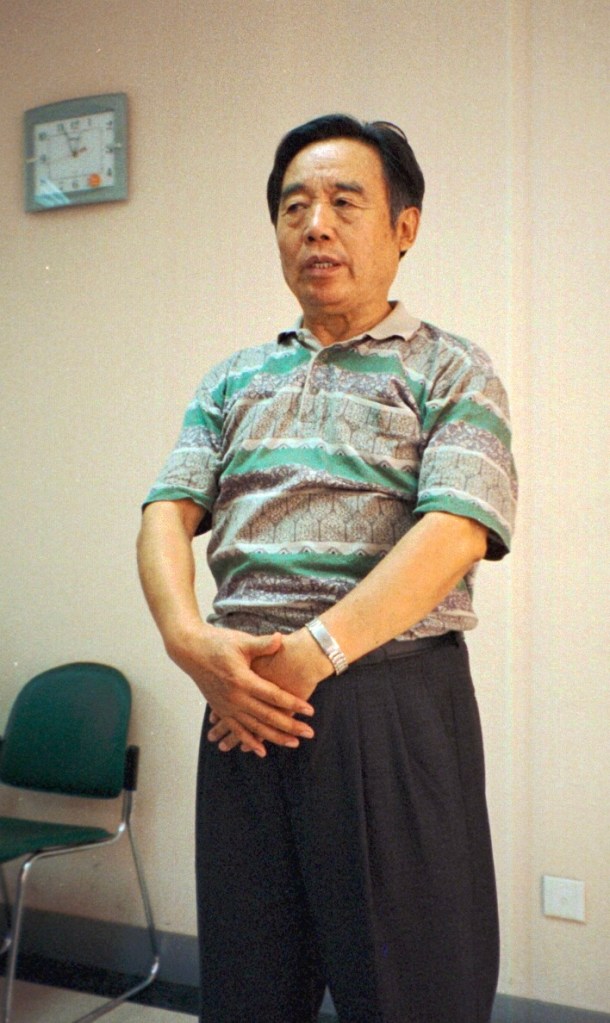
Click here for a half-hour standing form of Turtle Qigong (Part 1), ‘Watching the Turtle.’ It is the basis of my beginning Qigong classes. This is a gift of the Wang family in Beijing.
Students in my classes may download this for free. All others are encouraged to make an adjustable donation to actively support sharing Qigong by clicking here.
I made this video in Hawai’i during the peak of the pandemic for my employer, Oregon Health & Science University, where I was doing acupuncture and teaching Qigong to medical students and researchers.
My experience teaching this form over the decades in 4 time zones is as follows:
- The first movement is very energizing. Connecting with the front door to the lower Dan Tian or Sea of Qi, as well as the tailbone on the back does this. The tailbone has a lot of Yang Qi: I observed as an acupuncturist that injuries to this area always had a burning, fiery sensation. The Kundalini of yogic practices lays dormant here. By tapping on these points front and back, the deep Jing-Essence and Yuan-Source Qi is activated. When I first taught a two-hour class on this once a week, I spent too much time talking and had time only to share this first movement. Out of a class of 40 students, 3 or 4 would report the next week that they had too much energy to know what to do with: They slept only 3-4 hours a night for several nights after the class. I always made sure to at least teach the second movement; there were no further problems with that.
- The second movement is calming and also activates the Microcosmic Orbit, a feature of most every Qigong form I studied. This is a relaxing meditative practice that can be done on its own. Starting in the Lower Dan Tian in the middle of the lower abdomen, Qi is drawn down to the perineum’s acupoint at Ren 1, up through the tailbone and along the spine to the top of the head, then down the anterior midline to complete the circuit in endless loops. This clears and connects to two of the most important channels of acupuncture, the Ren and Du. All Yin channels flow like streams and rivers into the ocean of the Ren, and all Yang channels merge in the Du. Keeping the tip of the tongue on the roof of the mouth of the mouth–without tension–connects these normally separate channels. This prevents Kundalini Qi from running up the spine and getting stuck in the head, leading to uncomfortable complications. The Daoists preferred allowing the Qi to run down the front as a safety valve that also nourished the organs. Meditating on the Microcosmic Orbit is immediately calming and balancing. When clear, both physical and mental diseases are on their way to healing. Wang said that doing this part of the form could be done by itself for insomnia. This definitely worked for me in coping with jet lag while returning from China. I tell patients to do this movement if they can’t sleep, and then sit on the edge of the bed and meditate until getting sleepy.
- The third movement activates and clears the channels lower limbs, much like the first movement does the same for the upper limbs. My experience was striking in observing patients with lower body pain who used walkers during the first week of learning this form. After a month of weekly classes, other students were very surprised to see these same people stop arriving with their walkers and using elevators, just using stairs like everybody else. I can’t think of a student who continued using a walker in my public classes.
REPETITIONS
The specified number of repetitions for each movement is either 33, 66, or 99. The first option takes about 10 minutes, the second 15-20, and the latter about a half hour. Most Qigong standing and sitting forms I studied take about 30 minutes. Wang explained that this is a natural cycle for both blood and Qi in the body.
Beginning classes start at 33. Within a few weeks, 66 meets the needs of most groups. However I always get them to 99 at some point. I tell students that several of mine reported that 99 repetitions have a powerful effect, going beyond the length of time.
In Chinese philosophy, numbers have a Qi or feeling that has effects. Odd numbers are Yang and even numbers are Yin. In the Yi Jing, China’s oldest classical text that is the root of medical philosophy, 3 is Yang, and 9 is the ultimate Yang. 99 is 9 times 11, very Yang indeed. A hallmark of this form is to become calm like a turtle, so that the cosmic Yang energy can be received harmoniously.
VISUALIZATIONS
Qigong forms often combine visualization with movements, for inner and outer aspects. The first visualization of watching the turtle on the ground can lead to dizziness in a few students. This occurs to several people in a class of 30-40. It seems to happen to students who are the most open to the form, like a powerful rush of energy that can be a bit overwhelming. If nausea occurs, I tell them ahead of time to just sit down, relax, and disengage from the form. We find this during very powerful acupuncture treatments as well, where the process must be moderated when too intense. Sometimes it occurs from lack of sleep or skipping a meal prior to an acupuncture session, but other times it is just too fast of a change for comfort. The more people who experience a bit of this during a class, the more I know the Qi is “on.”
The ending visualization is the penultimate part of the form. The first 3 outer movements are preparation for it, according to Wang. They harmonize the body’s Qi for a good meditative experience. He specified 10-15 minutes for this part. In classes of North Americans, this is difficult. People can get restless after 5-10 minutes, as they are not used to standing still and doing nothing. Some classical approaches start students with standing like a post. This can lead to great results for dedicated practitioners. However this way is daunting for those without cultural familiarity with its value, or whose channels are particularly blocked. Most modern people have body blockages and imbalances from not walking or moving naturally in their lives.
POINTS OF ATTENTION
In extensive teaching of this form, some of the common issues that some students make bring out healing aspects in the form.
1- For the first movement, connect the commonly used acupoint LI 4/He Gu with the tailbone on the back and below the navel on the front. The front acupoints on the lower abdomen that are gateways to the Lower Dan Tian are specifically Ren 4-6. Many people are unfamiliar with their own energetic anatomy, and may connect random points instead that will be less energizing. The hands lead the movements here. Find the points with precision, and then go into relaxation. Always remember there is a pause in between the movements. Movement is Yang; stillness is Yin. By having the same amount of time, about 1 second each here, the body is given the opportunity to take what it needs from the experience. It also allows the Qi to go in deeper.
2- It is common for beginners to exaggerate the movements of the second part. It feels good for them to open up the shoulders at first, but pretty soon a deep forward bend with large arm movements will wear them out. Turtles can swim for thousands of miles. I sometimes tell people at this point, “Less movement, more Qi.” The imagery of swimming after the turtle here may inspire large and splashy movements. Over time, the body through its fatigue will show the student the most efficient motion here. It is more like rowing a boat: the arms are straight, the hands lead the movements, and are facing the body the whole time. Also, the motion is continuous except for a pause when standing fully upright. At that moment, the crown of the head is connected with the sky. Some students pause while bent over instead, causing undue stress on the lower back. Wang said, “Everybody does this part of the form a little differently, but the key words for the movements here are slow, soft, gentle, quiet, and relaxed.”
3- The simple dance step is only 3 steps, but some will habitually add a 4th step. Three is a Yang number that builds energy and unity; 4 is dispersion (and death) in Chinese number theory. The Turtle form generates and receives abundant energy in many ways. In a class, most people go in and out in a circle: Some will wander off with their eyes closed, and this is fine. While practicing alone, you may wind up facing a particular direction, or making a slow circle as you dance. Each direction has a specific healing potential in Chinese medicine: for example, the North for the Kidneys, and the South for the Heart. A clockwise turn will draw more energy into you, while turning to the left disperses. Follow your body.
For the visualizations, some will see different colors. During acupuncture and meditation, participants often see one of the 5 primary colors of Chinese medicine. At those moments, they are experiencing a spectrum of healing for the related channels. For example, if they see shades of blue or green, their Liver and Gallbladder channels are active. The golden yellow color of this form relates to the Earth phase, which is the Spleen-Pancreas and Stomach organs & channels. A speaker on Feng-Shui landscape design on our China trip mentioned that this color is seen as the most auspicious, thereby the most healing color; Red is a close second, the color of the Heart.
There are also two common experiences with the visualizations in a class. About half the class will see their turtle very vividly, with different colors, appearance, and sometimes a message for them. The other half will barely be able to see any form, as if in a fog. The first group gets excited, while the second can feel disappointed in hearing others stories. I tell them that people get exactly whatever they need during this kind of practice. Don’t judge yourself or make comparisons to others. After a month or so of weekly classes, the lively turtles in the first group calm down to a less stimulating, more meditative experience. The second group is gradually able to see a turtle come to light. Both groups balance and potentially inspire or ground the other. This is one of many advantages in a group practice.
 Qigong Meditation