The term Qi–pronounced ‘Chee’–in Qigong, is loosely translated in English as ‘Energy.’ This is sufficient for a general understanding of Qigong.
At a deeper level, Energy is a very specific term in Physics. One of its hallmarks is that it diminishes over space.
Research was done on long-distance transmission of Qi in the United States by engineers on the Chinese Qigong healer Dr. Pan, Xin. These very sophisticated studies documented that healing Qi’s effect on substances can increase over distance, the opposite property of Energy in Physics.
Chinese characters are fun to look at. They are combinations of symbolic pictures that give a more direct insight into these words. Adult learners of Chinese find a lot of helpful meaning in the original symbolic meanings. There are typically several images within each character, also called ideograms, such as the one for Qi:
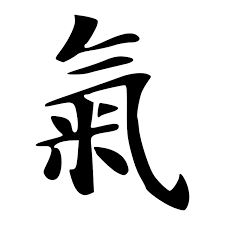
The Chinese ideogram for Qi looked different in the stone-age oracle bone writings of the Shang dynasty: 气. The 3 upper lines are said to be breath or vapors. Three is a sacred number in Chinese philosophy, one that encourages unity as energy coming together: These lines are united by the top left line. It is associated with the Three Treasures: Heaven, Humanity & Earth or Sun, Moon & Stars. The lower half of the character to me suggests something floating lightly, open yet dynamically balanced.
Later on, in the Han dynasty when Chinese culture more thoroughly coalesced, the lively character for rice was inserted below: 氣. This rice character looks like a small explosion, which is what food provides in the body. Food and Breath are two of the main physical ways we nourish our Qi.
Learning Qigong, we quickly find ways to replenish our Qi beyond food and purely physical inputs. Much of that exciting rejuvenation and open quality is conveyed by the older character. Both are used today.
 Qigong Meditation
Thanks for sharing a mutual interest