Where the mundane meets the Cosmos
Many people experience sinus congestion to different degrees. It appears to be a design flaw in our human species, and is worsening with climate change. Treatments with medications often have complications (sedation), or very low compliance with the overflow effect on sleep apnea (sinus rinsing is a tough sell for my patients; c-pap and other machines have a very low compliance rate after a year).
Self-acupressure can do a lot of good for preventing and self-treating sinus issues. The Turtle Massage Form on this site is a good example. Basically pressing any tender point over the sinus 20-30 times will help, along with under the ear lobe to clear nearby lymph if tender. Finish with the back of the head, under the occiput, to clear the entire head.
Materially, we can write the problem off as an irritating inconvenience. In acupuncture based on Chinese medicine, phlegm in the sinus interferes with the brain and consciousness. In Ayurvedic medicine from India, there is a direct connection when we clear the sinus with alternate nostril breathing and the 3 Central Channels.
Why do alternate nostril breathing?
Most of us have one side of our nose that is blocked more than the other. It can be from a deviated septum or lingering infections. Closing one nostril while breathing through the other has a calming and balancing effect. It may help insomnia–another common malady.
An acupuncture student of mine related how Tibetan meditation teachers practiced this. She was struck that no matter which school or practice they did, all of the ones she knew started their day by sitting on the edge of their bed and doing alternate nostril breathing. They would make a fist with one hand and place it on their upper thigh, their knuckles pressing into the acupoint Liver 10. This helped create an upright posture. The other hand presses one nostril to breathe in on one side and out the other. This can be done in a single breath, but they would usually do several waves or puffs of air. This strengthens the diaphragm and helps open really blocked passages.
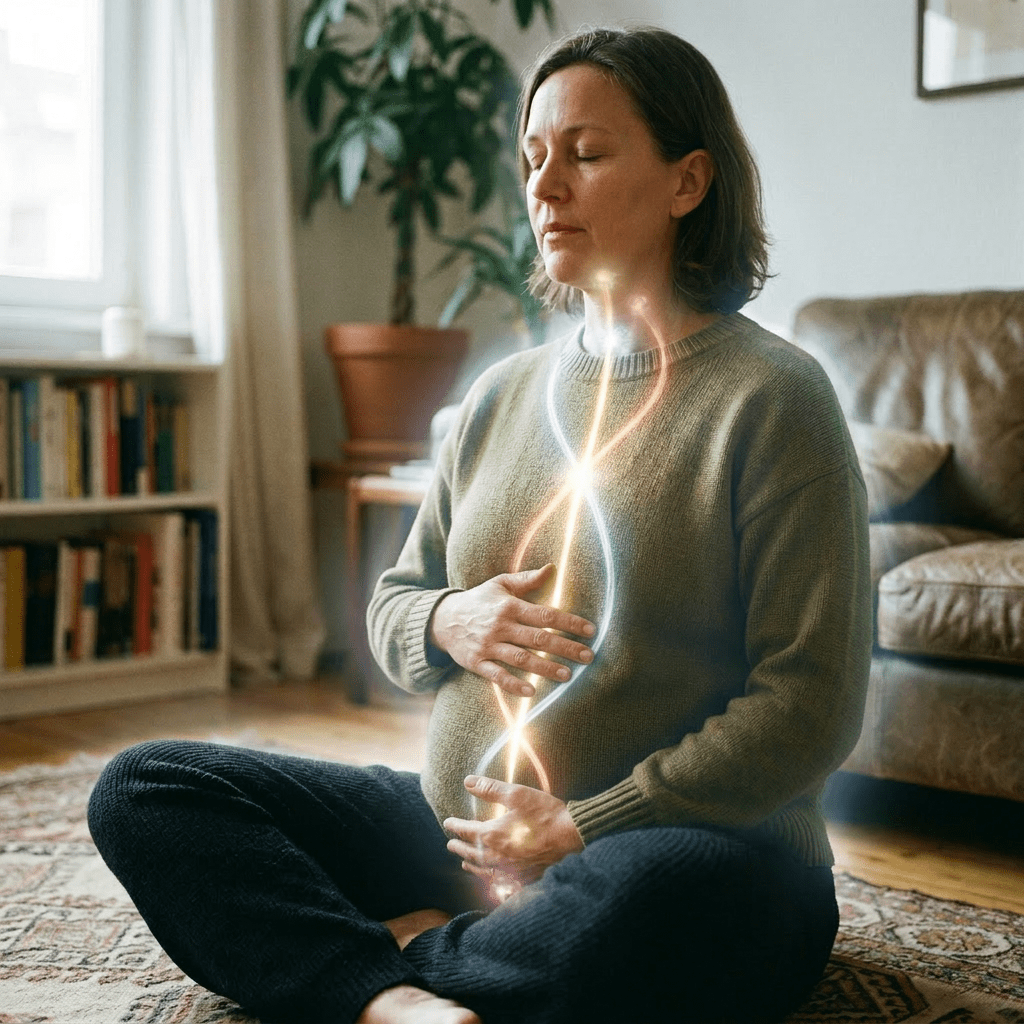
With Qigong, there is always an inner and outer aspect to a practice. The inner part of the above practice is to breathe in and out of the Central Channels. These are 3 subtle lines of energy, central and lateral, going from the crown to the root of the body. These are a main part of the traditional Ayurvedic medicine of India, which was imported up to Tibet and well-preserved there.
When breathing in or out of the left sinus, one can imagine breathing all the way down a channel just left of center that goes through the heart and into one’s root. The right side goes through the liver. When the two lateral channels are balanced, then the center comes to life as a latent potential. These 3 channels are a major component of Ayurvedic medicine. They also anchor Buddhist psychology (Abidharma) through a mind-body connection:
| Channel | Left-lateral | Central | Right lateral |
| Bio-energy: Dosha or ‘Humor’ | Wind | Phlegm | Bile |
| Representative Organ | Heart | Stomach | Liver |
| Psychology | Attraction, desire; calming, cooling | Clarity or Ignorance | Aversion, hatred; activating, warming |
| Name | Ida | Sushunma | Pingala |
These channels are not mentioned in acupuncture, but they are key in Chinese Qigong. Both Chinese and Indian sources agree that the Central Channel is a latent potential that is activated through meditative practices, like Qigong and yoga. Acupuncture is interested in the more mundane energetic anatomy that is shared by everyone (what they term ‘post-natal’); Qigong aims for spiritual potentials (the ‘pre-natal’ dimension described on another Page in this site).
The Central Channel in Qigong may be activated through twisting movements, such as Turtle Qigong’s first movement in the first standing meditation.
What this knowledge of energetic anatomy can accomplish is to make basic health practices like alternate nostril breathing more meaningful. This generates interest to keep a practice going. Try it, and see how you feel.
| A practice to try- – Sit on the edge of your bed, either on rising or the last thing you do at night. – For the hands, either place one hand down on your thigh, or press knuckles into the thigh below the groin while raising up the shoulders. – Close one nostril with your other hand (maybe thumb or ring finger) – Exhale out of your belly, while imagining clearing a lateral central channel, in 3 waves or puffs – Inhale in 3 waves through the opposite side – Repeat until the sinus is more clear, and/or a connection is made with the lateral central channels, then reverse – One side of the nose will always be more blocked, so close the other nostril part-way to equalize the pressure, as you exhale and then inhale in 3 waves into your belly. Imagine a central channel being cleared through your center, down to your belly. |
One local Tibetan teacher near here, in Crestone Colorado, writes that these 3 channels meet in the middle of the lower abdomen. He describes it as inside the acupoint known as Ren 4 (or CV 4). In Qigong, this is the lower Dan Tian that is a major focus of practice.
 Qigong Meditation
Thanks for sharing a mutual interest