
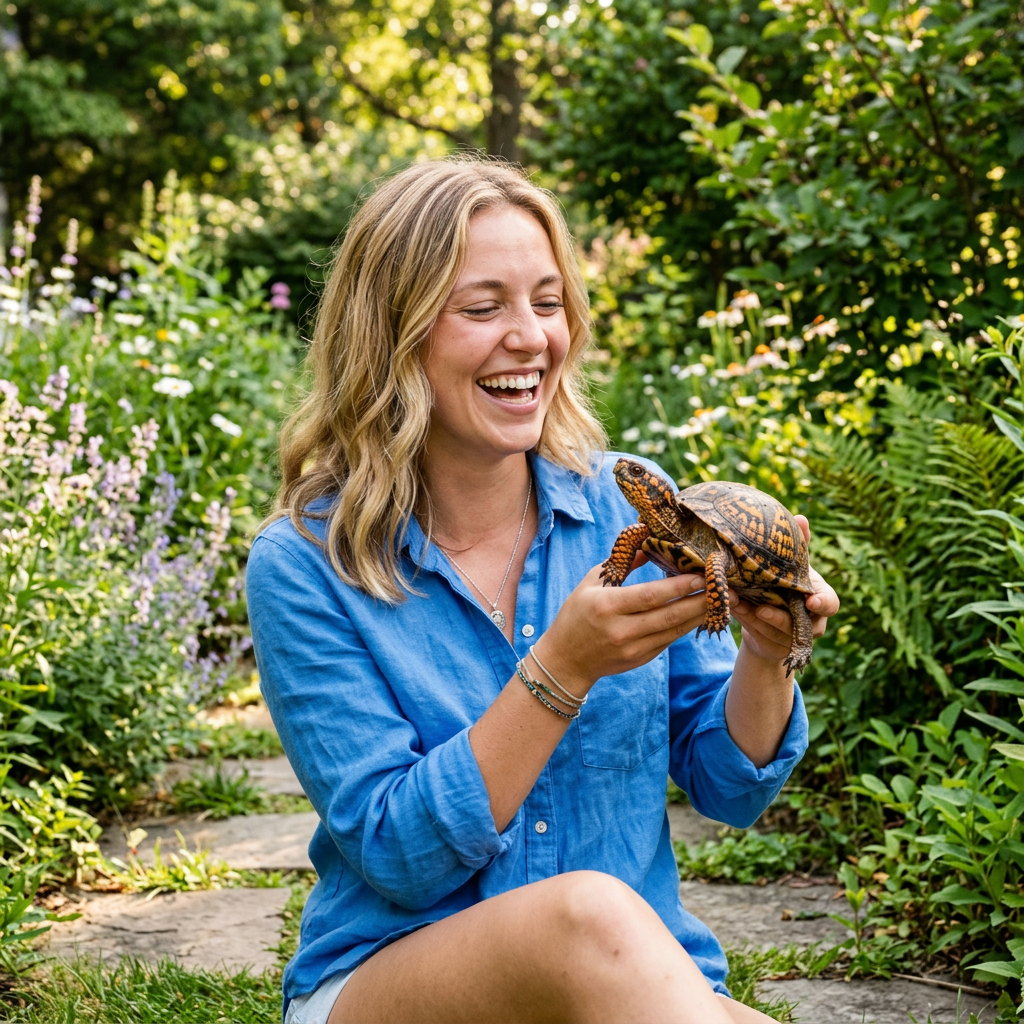
There must be a connection between Qigong and Joy, or people would not bother with it. Yes, there are tangible and concrete outcomes for practicing Qigong, such as better health markers. Joy is both an outcome and a driver of better health. I have seen patients with dire health situations who show moments of joyful bliss or calm during Qigong classes. In my own practice of Turtle Qigong, I can count on many minutes of blissful, golden joy felt in my brain, flooding my body just after engaging the preliminary visualization. It took some time to develop a relationship to the form first for that to happen. I also went through times with other forms when other feelings would come through, such as the year when tears would flow with most any form I practiced.
Joy in the my understanding of Buddhist psychology (Abhidharma) is not to be clung to, nor even sought after. The point of the mind is to be open. My finding is that a mind that is stable has an easier time opening up and staying that way. Acupuncture and Qigong, in my experience, are both capable of stabilization, greater capacity for calm awareness, and moments of inexplicable joy.
There are many reasons not to be joyous or happy, especially now. As I was getting local produce at an outdoor market, a friend I know who seems very reasonably engaged in the planetary challenges that we all face challenged me with the question, “What are you so happy about?” I was smiling for no particular reason while holding a bunch of kale–maybe my favorite vegetable. There were severe wildfires that moment in France, and maybe that was her despair at the moment.
In truth, we cannot all be in sync with each others emotions. There are those I’ve met who face the most severe socially-induced life-challenges who are upbeat, and others who are joyless no matter what.
In Chinese Medicine (whether Classical Chinese Medicine or contemporary, integrative TCM variants), joy is clearly a matter of the Heart. Both classical and modern Chinese language refers to the brain with the same word as the Heart (‘Xin’, pronounced ‘sheen’). This organ is said to house the Spirit, called Shen, which is loosely translated as consciousness, or the light of awareness. In its normal, healthy state, the Heart and Shen are calm, clear, and light. These are manifestations of joy, which is the positive emotion associated with this organ. It is a slightly different kind of joy than what many of us grew up with, with holiday surprise presents as children, and chemically-induced states of happiness as adolescents. These more artificial types of joy have diminishing returns with each use, and many complications. The Asian concept of joy may be closer to ‘contentment,’ but it can go into a natural process of bliss. These concepts are very important, given that the main cause of death is heart disease. Our relationship to Joy in TCM is an indicator of heart health.
The Standard American Diet (SAD for short, a truly accurate abbreviation!) is known to be heart-deadly. Summarized as ‘meats and sweets,’ the newer keto versions promote meat. What becomes fatal is the clogging of blood vessels with excessive fats. This causes a lack of circulation throughout the body, and may deprive us of joy for no reason. You may not agree with the conventional science on this, but we can all agree that joy requires some physical basis. We can’t use practices like Qigong to overcome chronic lifestyle issues: that only goes so far.
Joy is our birthright, our natural state. Qigong is about finding that re-connection to nature. In my experience, Qigong can bring the joy we feel in nature into urban environments.
While living in Colorado, I wound up doing Soaring Crane Qigong. It was the first form I learned, and I used it there as the only form that could help sore lower limbs from the long drives sometimes required in those wide open spaces. There were many wild animals that lived in my neighborhood, but the one that induced the most awe and joy in a friend of mine there were the sandhill cranes that migrated over my house. These huge birds were the very same ones that were associated with this form from China.
Similarly, while living in Hawai’i, the form I do the most here is Turtle Qigong. It’s the one I’ve taught the most, and that my original Qigong teacher, Chen Hui-Xian, recommended to me as a base form. She taught us many forms, but could notice which ones were a favorite or a deep connection.
In Hawai’i, I volunteer at our favorite beach to help tourists from all over the world navigate the rocky shores of an excellent habitat for snorkeling. We see a lot of fish there, but the one form of life that generates the most excitement, by far, are the green turtles. The Hawaiians call them ‘Honu,’ and they are one of the half-dozen or so animals that get associated with family lineages traditionally, as a kind of protector.
What are the chances of these alignments? I learned a family lineage Qigong form from China based on a turtle. While there, I would hike in woodlands above the pollution in Nanjing, where centuries-old turtle statues guarded fort entrances that were built in the Ming dynasty.
Now, with the declining coral beds from global warming that feed the local turtles, I volunteer to keep tourists from trampling the coral that is left. I feel good when I am protecting these creatures.
What are the chances– How did I get here, in the big scheme of life? I am happy to ponder this, to live it.


Thanks for sharing a mutual interest